Test protocol
Two maximal runs, evenly paced, ideally on a 400 m track. Everything in your report builds on them.
Important: Your two runs are the basis of your entire report. Run the test rested, well fuelled and fully motivated.
Adactiv Diagnostics builds a physiological profile from two runs. For that profile to be as good as it can be, the test data has to be clean. What matters is not only a fast pace, but two standardised, evenly paced and maximal runs.
So treat the test like a race: arrive rested, charge your watch and lay out your fuelling. Don't start overexcited: you can always push on later. What counts is a pace that is as even and as high as possible. Your last larger meal should ideally be 3 to 4 hours before. No hard session and no long run the day before.
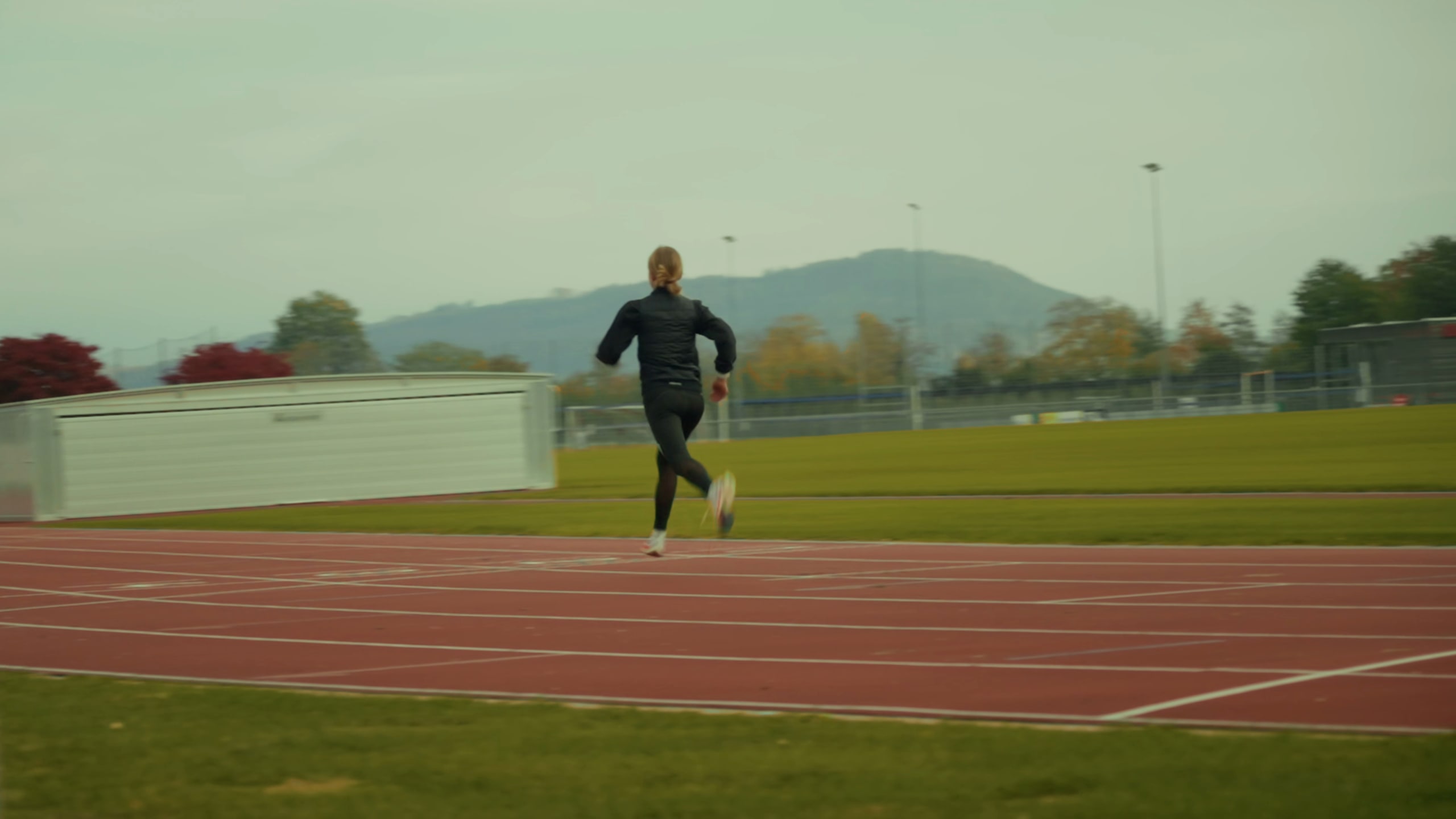
A 400 m track is ideal. The laps give the exact distance, and there are no GPS errors, no gradients and no interruptions. Run in the inside lane so the distance is right.
The test
The test is two maximal runs: a short one and a long one. From the two times we determine your Critical Speed and your D′, and from those your predictions, zones and plan.
- Short run3 to 4 minutes
- Long run12 to 17 minutesideally no more than 18 minutes
Which distances?
Pick the distances to aim for by your current 5 km time:
| Your 5 km time | Short run | Long run |
|---|---|---|
| under 16:00 | 1200 m | 5000 m |
| 16:00 to 18:00 | 1200 m | 4000 m |
| 18:00 to 21:00 | 1000 m | 3000 m |
| 21:00 to 26:00 | 800 m | 3000 m |
| 26:00 to 32:00 | 800 m | 2400 m |
| over 32:00 | 600 m | 2000 m |
If you don't know your 5 km time exactly, estimate it. The runs don't have to fit the range to the second. What matters is that both are run evenly and flat out.
The test day, both runs in one session
Warm-up (20 to 25 min). 15 minutes easy. Then 3 to 4 strides over 80 m, walking back easily. Then 3 to 5 minutes easy until the start. You can also do your usual race warm-up, with running drills for example.
Run 1: the short run (3 to 4 min). Run your chosen distance as fast as you can hold an even pace. The exact duration matters less than an even, maximal run all the way to the finish. Don't save anything for the long run: both have to be true maximal efforts.
Active recovery (20 to 30 min). Jog or walk easily. Stopping briefly to drink or eat something is no problem.
Short warm-up. Before the second run, a few more minutes easy and 2 to 3 strides.
Run 2: the long run (12 to 17 min). Again, what counts is an even, maximal run at the highest pace you can hold to the end.
Route. Ideally, run both on the same route.
Cool-down. Afterwards, 10 to 15 minutes of easy running.
What you upload
- the FIT files of the runs (exported from your watch or app)
- distance and time of both runs
- whether both runs were on the same day
- sex, age, weight and your maximum heart rate (without it, the highest pulse in the file counts)
- optional: your next target race, with its distance and date
- optional: a race time over a longer distance from the last 3 months, a 10 km or half marathon for example. It makes the prediction for long distances more personal.
Consistency beats perfection
Test as consistently as you can:
- the same run durations as in your last test
- the same routine (one day or two days)
- a similar time of day
- similar food and caffeine
- similar freshness
Keep to these and you can measure your progress as well as possible. A retest every 6 to 10 weeks is a sensible interval to track your progress. Make sure you choose the same protocol for the retest: the same run durations and the same routine. Choose one protocol and stick with it.